
Introduction:
“Margazhi” refers to the ninth of the twelve lunar months per Tamil calendar. In comparison to the Gregorian calendar, this Tamil month maps approximately to the period between Mid-December of one year to the mid-January of the following year.
This is a period of pious activities among the spiritually inclined Sanatana Hindus. These spiritual activities are traditions that continue thru’ centuries. An approximate timeline of the earliest practice of these traditions could be from 8th Century A.D. This is based on the life period of the poets who penned various hymns (Paasuram in Tamil) that are sung widely during the “Margazhi” spiritual activities.
One can deeply review different elements of the traditions and endeavor to realize facets of a rich heritage. Representative view points on the following are outlined in this article.
- The socially all-encompassing nature of the spiritual activities: Indicators from the “Margazhi” Traditions:
o The tradition indicates an all-encompassing participation & sharing of “prasad” (food that is spiritually prepared) among the spiritually inclined without any discrimination of caste or creed.
- The Scientific, Technological, Human Resource Focus & Economic Structures thru’ history: Indicators from the “Margazhi” Traditions:
o The hymns from the time upon close review indicate a rich set of social, scientific & economic life centered on Temples with spiritual intent. This pre-dates European Renaissance by approximately thousand years.
- The “way of life” – Human Life Objectives: Indicators from the “Margazhi” Traditions
o The Hindu Sanatana Concept of “Purushartha” – Objective of human life, sees life as a path to divinity. This concept sublimely pervades all human endeavor and becomes the cornerstone of one’s intrinsic motivation rather than external influences. This could be compared and duly contrasted with the more modern “Maslow’s Hierarchy of Human Needs”.
A wider, deeper, comparative review of Margazhi traditions provides significant insights into Sanatana Hindu Values and their relevance today.
The socially all-encompassing nature of the spiritual activities: Indicators from the “Margazhi” Traditions
Spiritual Activities during the month of “Margazhi”
During the month of “Margazhi” the spiritually activities include:
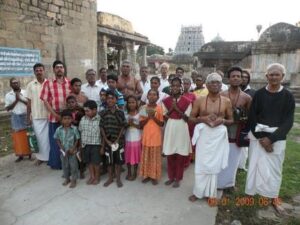
- Hymn Recitals in groups: “Tiruppalliezhuchi” by Thondaradipodi Azhwar, Tiruppavai by Andal. They are recited in Vishnu temples by the followers. The Saivite (Shiva) followers recite “Tiruvembavai”. These are recited as “Nagar Sangeerthan” Bhajans and in Temples.
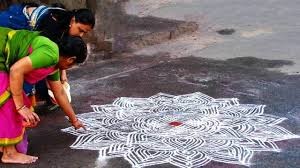
- “Kolams” @ Individual Door-steps: The girls and women at home wake up early to lay out “Kolams”. Kolam is a symbology driven art form, that is done with a mixed flour or more often with “rice flour”. This is spatial and maths (matrices) based art which is laid out systematically starting with “flour” dots that are connected in patterns to bring out a form which then is colored and decorated.
- Practice of Abstinence – Fasting: “Margazhi” is a month of fasting & abstinence for several spiritually inclined followers.
o Several followers participate in temple pooja & recital in the morning have the prasad that is offered in the temple, then fast for the rest of the day to participate in the evening pooja then have the simple prasad offered after that to complete the day.
o Traditions include avoidance of sweet for major portion of the month.
These traditions are followed by several spiritually inclined believers irrespective of their caste or creed.
Seasonal Significance of “Margazhi” & the Human Resource Purpose behind the Traditions
Seasonal Context:
“Margazhi” coincides with the “Winter Solstice” when Sun is at its farthest from the Earth. During this period the early morning “Ozone” layer is at its purest compared to rest of the day. This provides the best possible atmospheric air for breathing throughout the period. When one follows the traditions, the early morning activities of “Nagar Sangeerthan”, laying out “Kolams” and abstinence in general increases one’s ability to breathe the pure air. This breathing is also facilitated by the focused efforts on with associated activities like rhythmic singing and involvement in the artistic expression of the “Kolam”. This becomes a “sadhana” (practice) for the spiritual and physical well-being of the practitioner.

“Margazhi” is also a period of very minimal trade, professional activities in the Hindu, Sanatana tradition.
- Wedding or any new commencements do not happen during the month
- Agriculture which is the most prevalent economic activity is at its minimum effort during the period. Harvest happens soon after.
Carefully identified traditions designate this period to facilitate an inward focus for the spiritually inclined and to guide them to “Sadhana” (Practices) for spiritual upliftment.
Recognition of astronomical positioning with significant expertise.
The Hindu Traditions are significantly aligned to nature. Very early in History, humans could identify the relative position of Earth with the Sun as the one that impacts the seasonal changes, which in turn impact livelihood in terms of rains for agriculture and so on.
The Hindu “Panchang” (Calendar) is “Luni – Solar” in nature. Wherein the Months are identified with Moon’s orbit around the Earth and the years are identified with the Earth’s orbiting of the sun.
As we all know today that Earth’s orbit around the Sun is elliptical and the axis of the orbit is slanted.
The Hindu Sanatana tradition identified the movement of Earth around the Sun by including Star Constellation positions as reference points. With the references of Moon positions, Star Constellation positions which were identified over long period thru’ close observations (in the absence of telescopes in those era) and analytical predictions, Hindu tradition could establish a yearly “Panchang” calendar with fair accuracy. (One could observe that in other religious denominations such traditional calendars identify the same festivals in Winter one year and in Autumn another year.)
That the Hindu Sanatana “Panchang” (traditional calendar) is fairly accurate in comparison to the present-day calendars is a testimony to the Astronomical knowledge, the observation powers and the analytical prediction capabilities of the Hindu Sanatana ancestors.
This Astronomical Expertise dovetailed into the evolution of the spiritual traditions like “Margazhi” activities in line with the concept of “Vasudhaiva Kudumbakam” universal brotherhood and well-being of all.
Span of “Margazhi’s” Spiritual Significance
Geographic Span
Margazhi’s significance spans India and among other nations with significant followers of spiritually inclined Sanatana Hindus.
- “Margazhi” is referred to as “Dhanur” in several Indian languages. The spiritual significance of the month is shared in Temples across India, in Thailand, Nepal and by people of Indian origin in countries like West Indies, South Africa to name a few.
- “Andal” is a Goddess for several who don’t know Tamil.
Significance attributed by spiritual text:
“Margazhi” is the month when Bhagwan Krishna carried out the discourse of Bhagavath Gita (Geethopadesa) to Arjuna.

In Bhagavath Gita 10th Chapter Verse 35 Krishna Says
बृहत्साम तथा साम्नां गायत्री छन्दसामहम् |
मासानां मार्गशीर्षोऽहमृतूनां कुसुमाकर: || 35||
bṛihat-sāma tathā sāmnāṁ gāyatrī chhandasām aham
māsānāṁ mārga-śhīrṣho ’ham ṛitūnāṁ kusumākaraḥ
Amongst the hymns in the Sāma Veda know me to be the Brihatsama; amongst poetic meters I am the Gayatri. Of the twelve months of the Hindu calendar, I am Margsheersh, and of seasons I am spring, which brings forth flowers.
Spiritual Festival Significance:
“Margazhi” is the month of spiritual significance with two important days of abstinence viz “Vaikunda Ekadasi” and “Arudra Darisanam”.
Vaikunda Ekadashi:
- This happens on the “Shukla Paksha” Ekadashi thithi. Which is the 11th day of the Waxing Moon after the New Moon Day of the Margazhi month.
- On this day the “Sorga Vaasal” or “Parama Pada Vaasal” which is a special entrance to the Temple is opened in Temples devoted to Lord Vishnu.
- Most devotees fast throughout the day, be awake through the night and visit the Temple thru’ the “Parama Pada Vaasal” to complete their prayers then break their fast.
Arudra Darshan
- This is the day of “Arudra” – Star during the Month of Margazhi.
- This day Shiva is believed to have given his “Arudra – Nataraja” darshan to his devotee “Vyagarapaadha” Rishi (sage).
- This day is also believed to be the day when Shiva demonstrated the supremacy of divinity over karma to the disagreeing Rishis (sages).
- This is a day of abstinence, penance and fasting to the devotees.
Socially, all – encompassing nature of the traditions
The spiritual activities are all – encompassing to the spiritually inclined followers of the Hindu Sanatana Dharma.
The Hindu Temple activities during this month begin very early in the morning (4.30 AM to 7.30 AM). After the recital of Sanskrit slokas in the morning, the pooja will include the recital of Paasurams – Tiruppavai, Tiruppalliyezhuchi in Vishnu temples and Tiruvembavai in Shiva Temples.
Tiruppavai by Andal, Tiruvembavai by Manickavasagar are both in the point of view of a young girl who display deep affection to the lord (Tiruppavai on Vishnu, Tiruvembavai on Shiva) and endeavors to become one with him in spirit. These hymns (paasurams) are recited by all devotees who are inclined to do so in the temple. This recital is also considered as part of the “Aagama” (Temple Procedure) in the Margazhi month.
Post the recital “Prasad” (Food prepared by spiritual procedure) is shared with all the participants who partake of it in the Temple premises.
This participation is socially all-encompassing without any differences. This represents a significant aspect of the tradition.
The Scientific, Technological, Human Resource Focus, & Economic Structures thru’ history: Indicators from the “Margazhi” Traditions:
Tiruppavai Hymn (Paasuram) with its meaning – indicators of scientific, technological focus.
Tiruppavai Hymn (Paasuram) 27
Koodaarai vellum seer govindhaa un_dhannaip-
Paadip parai kondu yaam perum sammaanam
Naadu pugazhum parisinaal nanraagach
Choodagamae thol valaiyae thodae sevip poovae
Paadagamae enranaiya palagalanum yaam anivom
Aadai uduppom adhan pinnae paar choru
Mooda ney peydhu muzhangai vazhi vaarak
Koodi irundhu kulirndhaelor embaavaay
Meaning
Hey Lord Govinda, who is known for victory over enemies,
After singing you we will get drums and many gifts,
And after being praised by all the people,
Wear we will the golden flower on our hair,
Wear we will golden bracelets,
Wear we will golden ear studs,
Wear we would then the golden flowers on the ear,
Wear we will ornaments on the legs,
Wear we will pretty new dresses,
Eat we will rice mixed with milk,
Covering the rice fully with ghee,
And with the ghee dripping from our elbows,
We will be together and be happy,
And worship our Goddess Pavai.
This hymn and its meaning at the outset are spiritual in nature, a young maiden praying and seeking favors from the lord. Beyond that, if one were to extend the context with the background of the period of origin, one could understand the following references:
- the various golden ornaments, the existence of the concept of commerce, trade as indicated by concept of buying the ornaments, dresses,
- the social activity of eating together after the spiritual prayers,
- the use of high-quality dairy (milk, ghee) in the food and jaggery
Similarly, the other hymns (in Tiruppavai, Tiruppalliyezhuchi, Tiruvembavai) refer to the acts of flower garland making, chariot making, taking care of cattle (animal husbandry), agriculture, building maintenance and so on. These indicate the period to be scientifically and technologically highly evolved with the constituent elements as below.
- Scientific Expertise: Astronomy, Mathematics, Animal Husbandry, Horticulture among others
- Technological Expertise: Architecture, Building Maintenance, Ornament Making, Metallurgy (Gold, Bronze, Iron & Steel, Copper, Brass), Carpentry
- Art forms: Sculptures, Music, Dance, Drama, Painting,
- administration and organization for all of the above,
- availability of workshops,
- training centers – gurukul as they were referred to during the early times
The “Margazhi” festival activities indicate the rich and capable heritage that continued thru’ centuries.
“Margazhi” Spiritual Activities: Indicators of Economic Structure
“Margazhi” Spiritual Activities thru’ centuries are centered around Temples. Most Temples were built either by Kings (Monarchs) or by Land Owning Gentry (Zamindars or Vassals.
Kings and Land Owners who built Temples, wanted the Temples to thrive beyond their time. So, they generously donated towards the same, typically their ministers and cohorts followed suit. The donations included lands, jewels, cattle (so that the temples could get Milk, Ghee among others for the pooja (Prayers). These donations were registered to be known to the following generations, either as stone inscriptions or copper plate inscriptions.
One such copper plate inscriptions referred as “Thiruvalangadu Seppedu” meaning Copper Plate inscription from Thiruvalangadu refers to such donation by Uthama Chozhan – the uncle of Raja Raja Chozhan. The period is approximately dated to 9th Century AD. This copper plate inscription is part of the Chennai Museum.
The States of Tamil Nadu, Kerala, Karnataka, Telangana, Andhra Pradesh have few thousand Temples. The temple walls (built of stone) have such inscriptions as well.
Temples had defined procedures for establishment, upkeep and for the Poojas (spiritual prayers and activities) – such as how and when poojas are to be conducted according to the “Panchang” (Calendars), how and when the festivals are to be conducted and so on. These were referred to as “Agama” rules (आगम, āgama). These are derived from Vedas themselves. The specific Temple may have a variation in āgama in line with the specific Deity at the Temple, the local seasons, the specific temple history among others. The specific āgama have been codified and factored in the Temple traditions.
This spiritual process āgama extended to specific administrative activities of upkeep of Temple lands, the wealth donated to the temple and the conduct of the poojas, festivals with wide spiritual follower engagements.
One could easily understand that given this background an economic structure evolved with Temple and its activities at the core. This Economic Structure was an alternate to the King’s court based & agrarian (Land owning gentry centered) economic structure – though King, Land owning gentry could be a contributor and a follower at the Temple, the Divine deity(s) remains the center with the āgama” being the guiding rule.
Such a Temple based economic structure is typically different from a King’s court or agrarian economic structure free of an individual’s idiosyncrasies. A participant of the structure like an Artist or a Goldsmith could pursue their craft to realize their potential.
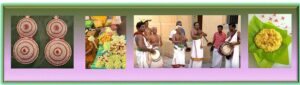
Such pursuits had divinity as a core value.
Such an economic structure provided for societal progress and individual’s intellectual progress resulting in overarching scientific, technological, artistic evolution. Modern History recorded European Renaissance which happened in 14th Century Europe to have brought forth such a progress.
The “Margazhi” festivities indicate that Hindu Sanatana Traditions have been able to build a progressive Temple based Economic Structure, that had significant Human Spirit defining structures like Brihadeeswara Temple among others nearly a Thousand years before the European Renaissance.
Today’s Businesses, Industries are bringing together people to perform professional activities in line with mutually agreed processes like ISO 9001 etc. The Hindu Sanatana ancestors conceived Temples as such Structures that will thrive’ thru’ generations for people to come together and collectively take forward a purpose driven life per processes – āgama. While also facilitating the spiritual pursuit of the individual towards “Divinity” with the “Deity”.
The “way of life” – Human Life Objectives: Indicators from the “Margazhi” Traditions

Way of Life Human life objectives: Indicators from the “Margazhi” Traditions
For Centuries the Sanatana Hindu – way of life “Purushartha” has been defined as below
- Dharma: Pursuit of a moral values-based life purpose. For example, a person wishing to be a Goldsmith will seek a teacher to learn the craft, pursue a life in terms of eating habits etc. so as to align to the craft’s needs like sharp eyesight, crafting abilities, handling the fire and so on.
- Artha: Pursuing a moral values-based financial gains leveraging the life’s purpose.
- Kaama: Pursuing life desires like marriage, children with morally obtained financial gains
- Moksha: Pursing life with the deepest desire to be relieved for birth-life-death cycle and attain salvation by divine grace.
Comparatively Maslow’s hierarchy of needs establishes the needs in a more granular manner in terms of Physiological needs, Safety Needs, Belongingness needs, Esteem Needs and Self actualization needs. The self-actualization needs transcend the external factors and commences the intrinsic interest of the individual to excel in their craft.
The “Margazhi” spiritual hymns reflect the progression of these “Human Resource Purpose” in a sublime manner in the background. The Tiruppavai 27th Paasuram (Hymn) was discussed earlier along with meaning. The last line of the Paasuram (Hymn) referred below
Koodaarai vellum seer govindhaa un_dhannaip ……
……………………………………………………………………..
Mooda ney peydhu muzhangai vazhi vaarak
Koodi irundhu kulirndhaelor embaavaay
Which means that “After Penance today we are eating Sweet Pongal Rice mixed with milk, jaggery and ghee in a manner that the Ghee flows from the hands to the elbow.
This is recited in the Temple premises among the devoted who
- include those who take care of cows to prepare ghee, that is so pure it flows from the hand to elbow the Yadavas
- those who till the land and grow paddy which gives the soft rice, that mixes so well with milk and ghee the farmers
- the kings, the commoners who partake of these festive prasad (Spiritually prepared food)
The above act of recital in such a gathering could be seen as a recognition of the Team effort of those take care of the Cattle and those who till the land in providing the ingredients for the Prasad with devotion.
The concept of Temple and the gathering for spiritual purposes attributes all objectives of life towards divinity. Yet the devoted will go thru’ life’s needs in phases. These Paasuram (Hymns) indicate the recognition of those needs and the endeavor to recognize the team efforts in taking forward the spiritual acts.
This is a sublime indication of the recognition of Human Resource Objectives in line with Maslow’s hierarchy of human needs.
The Hindu Sanatana “Way of Life” Objectives: Indicators from “Margazhi” Traditions and other Hindu Scriptures.
TIruppavai, Tiruvembavai Paasurams (hymns) directly mean a pious maiden spiritually seeking divine grace. The spiritual experts indicate deeper meaning for the same.
The Tiruppavai 27th Paasuram (Hymn)
Koodaarai vellum seer govindhaa un_dhannaip-
Paadip parai kondu yaam perum sammaanam
…………………………………………………..
Mooda ney peydhu muzhangai vazhi vaarak
Koodi irundhu kulirndhaelor embaavaay
In the hymn there is a reference to rice mixed with milk. While the direct meaning to the mixture of rice and milk is a reference to a widely understood food item. This is also a reference to the abode of the Lord Vishnu, which is mythologically understood as an ocean of milk “Tirupparkadal” in Tamil. With “milk” as a reference to the abode of Lord Vishnu the meaning becomes that as we enjoy the rice which is of earth, we are in one ness with you at your abode.
The interpretation then becomes as we lead the earthly life and do our chores, we are doing the same as an offering to the God.
This interpretation dovetails to the “Sanatana Hindu” way of life “Purushartha, in terms of Dharma, Artha, Kaama Moksha. As one pursue life’s objectives, the intrinsic motivation for the same should be to attain oneness with the divine Moksha.
Similar references to identifying the acts of life as an offering to divinity is available in several other scriptures.
Sri Rudram is one such example. Sri Rudram is part of Yajur Vedha. Its chanted widely as a penance from worldly life and salvation.
In the 4 the stanza of the Sri Rudram it is mentioned as below
4.11 नमस्तक्षभ्योरथकारेभ्यश्च वो नमो
Nama stakshabhyo ratha kar bhyascha vo namah
4.12 नमः कुलालेभ्यः कर्मारेभ्यश्च वो नमो
Namah kulalebhyah karmaare bhyascha vo namah
The meaning of which indicate
4.11 Prayers to the creator of the chariots
4.12 Prayers to the creator of earthen pots and the creator of Iron parts
The prayer proceeds to say that as they do these chariots, pots and iron parts they are Shiva and my prayers to them.
The prayer in this manner recognizes the way of human life while is to pursue the various crafts, professions, services its intrinsic motivation is to seek one ness with the divine. Moksha.
This concept of “Hindu Sanatana – Purushartha” – Way of life is to seek the Intrinsic Motivation towards divinity.
The “Margazhi” Spiritual activities severally brings forth the meaningful traditions and the glorious heritage in a sublime manner, while also facilitating a platform for the “Sadhana” practice for the devoted.
Let us partake in the “Margazhi” spiritual activities in Temples, be true to our Purushartha seeking our intrinsic motivation while ensuring overarching well-being to us and to the generations that will be coming forward.